

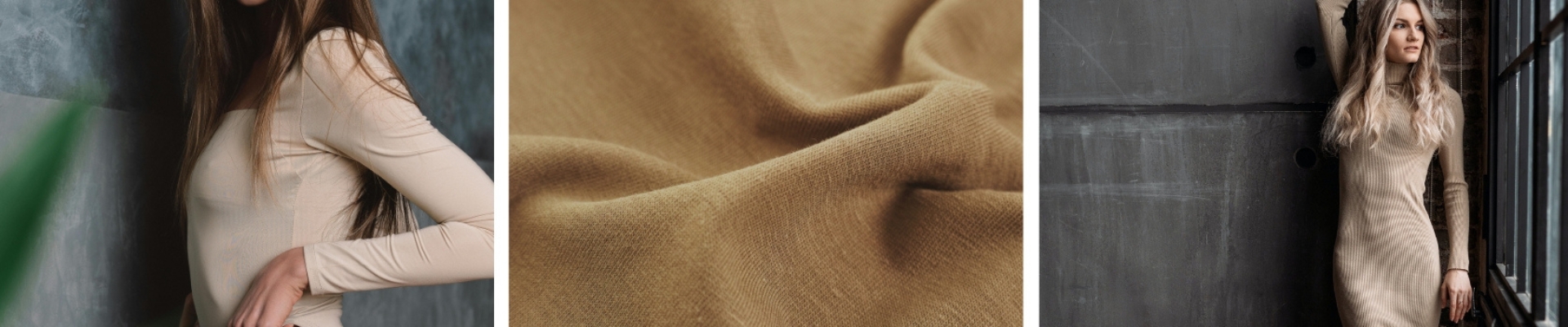
Il jersey è uno dei tessuti protagonisti assoluti nel settore dell'abbigliamento grazie alle sue straordinarie proprietà. Il nome jersey si riferisce alla gran parte dei prodotti della maglieria industriale realizzati su macchine circolari di finezza elevata. Scopriamo insieme tutto su questa straordinaria stoffa!
- CHE DIFFERENZA C'È FRA IL COTONE E IL JERSEY: il jersey può essere realizzato con fibre di cotone lavorate a maglia rasata. Il cotone, al contrario è una fibra naturale
- CARATTERISTICHE: opaco alla vista, morbido al tatto, elastico, confortevole all'indosso, resistente, facile da mantenere
- UTILIZZO: utilizzato principalmente per la realizzazione di capi di abbigliamento come t-shirt, pantaloni, gonne, leggings e molto altro
- COME SI LAVA IL JERSEY: lavabile a mano o in lavatrice a un massimo di 40°, va lasciato asciugare all'aria


Unicolour Cotton Jersey
7.95 €/mt


Dressmaking Unicolour Punto Milano Knit
8.00 €/mt


Dressmaking Lightweight Jersey
6.90 €/mt


Unicolour Viscose Jersey
7.00 €/mt


Dressmaking Plain Ribbing Jersey
5.50 €/mt


Tubular Ribbed Jersey Cream
7.50 €/mt
Tubular Ribbed Jersey Black
7.50 €/mt
Tubular Ribbed Jersey White
7.50 €/mt


Dressmaking Viscose Cashmere Blend Knit
9.90 €/mt


Cotton Jersey Unicolour
6.00 €/mt


Yellow Cotton Jersey
7.00 €/mt
Promo
Coming soon


Jersey Cotton Tulips Coloured
6.90 €/mt
12.00 €/mt
-43%
Coming soon


Jersey Cotton Ribbed Jersey Pink
13.90 €/mt
Coming soon


Jersey Cotton Ribbed Rhinestone White
13.90 €/mt


Jersey Cotton Horizontal Stripes Multicolour
12.90 €/mt


Dark Grey Lurex Silver
13.00 €/mt


Summer Vibes Cotton Jersey
12.00 €/mt


Jersey Cotton Floral Jersey Warm Tones
12.00 €/mt
Promo


Jersey Cotton Fantasy Lemon
8.00 €/mt
12.00 €/mt
-33%
Coming soon


Ivory Perforated Sweater Pure Cotton Flowers
11.50 €/mt


White cotton jersey Dolci Bassotti
12.00 €/mt


Pure Cotton Beige Knitwear
13.90 €/mt


Pure Cotton Camel Sweater
13.90 €/mt
Coming soon


Jersey Floral Pattern White Background
13.90 €/mt
Coming soon


Red Metallic Jersey
12.00 €/mt


Pink Metallic Jersey
12.00 €/mt


Bronze Metallic Jersey
12.00 €/mt


White Metallic Jersey
12.00 €/mt


Gold Metallic Jersey
12.90 €/mt
Coming soon


Jersey Cotton Camel Background with Tigers
12.50 €/mt
Coming soon


Perforated jersey Autumn flowers
13.50 €/mt
Coming soon


Flower Fantasy Quilted Jersey
14.90 €/mt
Coming soon


Jersey Cotton Orange Flowers
12.00 €/mt
Coming soon


Jersey Ribbed White Delicate Flowers
13.50 €/mt


Jersey Cotton Background Beige with Fawns
12.00 €/mt
Coming soon


Jersey Cotton Parachute Bears
12.00 €/mt
Coming soon


Jersey Cotton White Stars
12.00 €/mt
Coming soon


Velveteen Nicky Flowers Toni Vinaccia
13.00 €/mt


Ribbed Knitted Sweater Brown Stripes
13.00 €/mt
Coming soon


Cotton Jersey with Donald Duck Pattern
12.00 €/mt
Coming soon


White Cotton Savannah Animals Jersey
12.00 €/mt
Coming soon


Jersey Cotton White Small Butterflies
12.00 €/mt

Jersey fabric is defined by the way it is constructed, being a knitted, stretch fabric rather than a woven material. Often called jersey knit, it is made by knitting yarns in loops which is how the fabric gets its stretch. In comparison, a typical woven fabric is made by weaving yarns of weft thread over and under the warp yarns which leads to a more structured fabric with little or no stretch.
Back in time, jersey was considered a cheap, useless material, but it reached fame and appreciation when iconic designers used it in their collections. Thanks to its versatility, excellent fit, elasticity and easy care maintenance, it is widely used in the clothing industry. Among its main features and benefits, we find its incredible elasticity, cause it's elastic both in length and width. Another benefit of jersey is its wear resistance; it is strong and resilient. Jersey can be made of fresh or warm polyester fibers, therefore you will be able to use this incredible material all year round.
Back in time, jersey was considered a cheap, useless material, but it reached fame and appreciation when iconic designers used it in their collections. Thanks to its versatility, excellent fit, elasticity and easy care maintenance, it is widely used in the clothing industry. Among its main features and benefits, we find its incredible elasticity, cause it's elastic both in length and width. Another benefit of jersey is its wear resistance; it is strong and resilient. Jersey can be made of fresh or warm polyester fibers, therefore you will be able to use this incredible material all year round.
Jersey fabric originated in the Jersey Island, in the English Channel during the Middle Ages, and it's the simplest knitted fabric, because made with a single series of needles (single knit) and circular machines.
The right side of jersey fabric is smooth with a slight single rib knit, while the backside is piled with loops. Originally made of wool, nowadays it can me made of cotton, cotton blends and other synthetic fibres. The easiest way to sew jersey is by using a zigzag stitch if you're using you sewing machine. If you want ti hand sew jersey, you need to use a rounded needles, to not break the stretch fibres. HISTORY OF JERSEY FABRIC
By the end of the 18th century, jersey was a heavy and warm fabric used mainly by fishermen. At that time is was a plain, knit fabric, but its natural stretch made it ideal for dressmaking. Jersey owns its fame to designers, who used this material in their collections since 1916. The introduction of this amazing material in fashion was a novelty at that time, since it was only used for sportswear and laundry. Still nowadays, iconic designers of that period are still remembered for their timeless jersey pieces.

FEATURES AND BENEFITS OF JERSEY FABRIC
Jersey is mainly used in dressmaking for its incredible features and benefits. Its fit on the body is perfect and you can find it available in many different colors patterns. Although it is a knitted fabric, it is ideal for mild season because it is lightweight and comfortable. Let's see into details the advantages and disadvantages of this material.
Jersey fabric advantages: elasticity, softness, breathability, high absorption, easy care and maintenance (wash at maximum 40°)
Jersey fabric disadvantages: it does not have particular disadvantages.
JERSEY FABRIC COMPOSITION
JERSEY FABRIC COMPOSITION
According to the fibers used, we can distinguish between various types of jersey: when the material is produced with double knitting machines, we would have the double jersey, which is a bit less stretch than the normal one. Let's see al jersey fabrics down below:
- cotton jersey (or interlock) made of 100 % cotton, has a matte appearance, it is soft and lightweight. It is ideal to realize fresh t-shirt and shirts;
- single jersey (or trikot), has an obverse and single knitted. Sometimes, a small amount of cotton fibers is added to viscose or to elastane to give elasticity to the material. Mainly used for children's clothing;
- lycra jersey: made of 80 % polyester, 20 % lycra. Mostly used to realize long dresses;
- viscose jersey: made of 100 % viscose, compliments perfectly the body once worn. Ideal to realize skirts, tops and much more.
- double jersey (or jersey romanit) : this one is produced with two series of needles and does not have a precise or fixed percentage of fibers since its a mix of spandex, viscose and polyester. It is more compact than other jerseys and that's why is more used to realize winter clothes.
- jersey jacquard: double face and knitted. The motif is knitted and not printed. Jacquard jersey is less stretch than other materials but has a beautiful drape. Is is usually a blend of cotton and polyester.
