

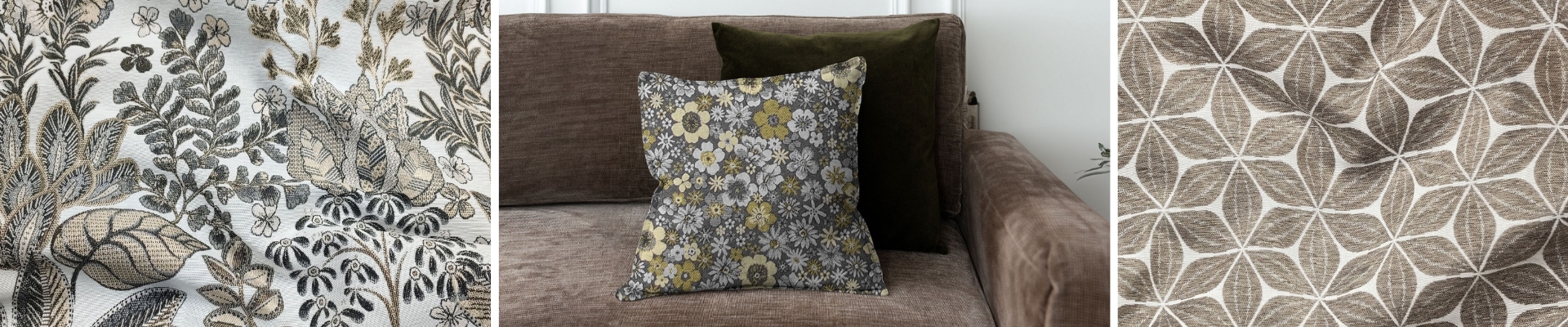
Questo prezioso tessuto operato, probabilmente di origine orientale, è lavorato con l'aggiunta di trame broccate, in filato lamellare dorato o argentato, in seta policroma, chiamate anche trame d'effetto. Il suo nome deriva dal latino broccus, che significa "dai denti sporgenti", stando ad indicare la presenza di decorazioni tessute in rilievo.
- CHE TESSUTO È IL BROCCATO: il broccato, caratterizzato dai suoi ricchi decori, appartiene alla famiglia delle degli antichi "lampassi", usati anche oggi nell'arredo.
- QUAL È LA DIFFERENZA TRA DAMASCO E BROCCATO: il broccato è formato da fili di più colori che formano un unico motivo. Nel damasco, invece abbiamo un unico filo
- COME LAVARE IL BROCCATO: consigliamo di lavare questo prezioso tessuto a basse temperature, evitando di strizzare la stoffa
- PER COSA SI USA IL BROCCATO: ancora oggi è richiestissimo per la realizzazione di cuscini, sedute e tendaggi e altri complementi d'arredo


Jacquard Abstract Geometry Grey H 280 cm
24.00 €/mt


Jacquard Leaves Green Background H 280 cm
29.00 €/mt


Jacquard Fiorellini
22.00 €/mt


Jacquard Botanical Fantasy Gold
14.00 €/mt


Floral Jacquard Black Tones
14.00 €/mt


Jacquard Floral Tones of Blue H 280 cm
26.00 €/mt


Jacquard Toile de Jouy Grey H 280 cm
22.00 €/mt


Green Woven Jacquard
24.00 €/mt
Coming soon


Floral Jacquard Neutral Tones H 280 cm
26.00 €/mt


Upholstery Floral Brocade - Air Force Blue
14.00 €/mt


Upholstery Floral Brocade - Grey
14.00 €/mt


Coming soon


Coming soon


Upholstery Gobelin - Retro Dogs
12.00 €/mt


Upholstery Jacquard - Gumballs
10.50 €/mt


Tessuto Jacquard Fiori Astratti Multicolor
10.00 €/mt


Upholstery Jacquard - Tulip Meadow
10.50 €/mt
Coming soon


Upholstery Gobelin - Zebra Print
19.50 €/mt

HISTORY OF BROCADE FABRIC
These precious materials have very ancient origins and feature refined motifs that give the illusion of a raised embroidery. The origins of this fabric date back to ancient China, that during that period was the world's silk main producer and used brocade for royalty and wealthy classes. Many different styles of brocade were born in China, like for example the cloud brocade. The refined and rich appearance of this fabric was enhanced by the use of silver and gold silk threads on its weave. Antique brocade was made by hand on traditional looms: a time consuming activity, but since that moment the popularity of this fabric began to increase and spread to the world through cultural exchange.
During Renaissance, this materials were a common pick in clothing and for decorative purposes. They were appreciated for their floral or pictorial design visible only on the face of the cloth.
Brocade is normally woven on draw looms. It is an additional weft technique in which the ornamental brocading is produced by a supplementary weft, together with the standard one that hold the warp threads together. In this way, the ornamental design will look actually embroidered on.
During Renaissance, this materials were a common pick in clothing and for decorative purposes. They were appreciated for their floral or pictorial design visible only on the face of the cloth.
Brocade is normally woven on draw looms. It is an additional weft technique in which the ornamental brocading is produced by a supplementary weft, together with the standard one that hold the warp threads together. In this way, the ornamental design will look actually embroidered on.
Thanks to the invention of Jacquard looms in the Eighteenth century, the production of this amazing fabric became actually easier and quicker, and it started to loose its association with upper classes and nobles. The use of brocades in dressmaking still remains rare, but it is appreciated in furniture upholstery and drapes.
BROCADE IN UPHOLSTERY
As we have already saw, nowadays brocade is much more used in upholstery than in dressmaking. Classic chairs and sofas are normally adorned with brocade cushions, and silky, designed drapes are most of the time brocade. For all those who love glitz and pomp home decor, it is not that rare to find sofas that features brocade patterns on the surface.

BROCADE FEATURES AND BENEFITS
HAND: stiff, heavy
COMPOSITION: nowadays, polyester and cotton
USAGE: upholstery, dressmaking
WASHING: we recommend to dry-clean it by a professional
COMPOSITION: nowadays, polyester and cotton
USAGE: upholstery, dressmaking
WASHING: we recommend to dry-clean it by a professional
TYPES OF BROCADE FABRIC
- Continuous Brocade: To obtain the desired design, the threads are hung on the backside of the fabric;
- Discontinuous Brocade: the additional weft is woven just into patterned areas
- Silk Brocade: Extra shiny and high-end fabric, usually used in upholstery and dressmaking;
- Synthetic Brocade: cheap and not expensive to produce, and it is not comfortable to wear.

WHAT IS THE DIFFERENCE BETWEEN DAMASK AND BROCADE
At first sight, these two fabrics may seem identical, but the main difference lies on the backside of the materials. The backside of brocade features many floating threads that can actually fray easily. This makes brocade non reversible, while on the contrary damask can be used on both sides. Moreover, damask usually consists of a single threads color, while brocade consists of multiple thread colors all woven together.
HOW BROCADE IS PRODUCED
The manufacturing and production of this rich material is very interesting. First of all, up to three threads or yarns used are dyed before weaving phase. Nowadays, thanks to computerized Jacquard looms, there dyed threads are weaved with extreme precision. Back in time and traditionally, weavers used to weave this intricate pattern on traditional loom, which required extreme attention to detail and precision,